Wednesday, June 15, 2016

Visit New Places, Connect, and Give Back
By Sheryl Kayne
Sheryl Kayne's Profile PhotoI always loved to travel but hated being an ordinary kind of tourist, staying in hotels for a few nights and buzzing through major sights at the speed of Superwoman. I wanted to experience the phenomenal difference between visiting a location for a time-limited vacation and integrating myself into the community as someone who belonged there. I needed to see, hear, smell, touch, and taste where I went, really getting to know the people and place. At the time, I didn’t know that what I wanted to experience was Immersion Travel.

What makes Immersion Travel different is that it means taking an active part—working, volunteering, advocating, playing or learning—where you visit in order to learn about the culture, traditions, and characteristics of each particular place, just like a local. Immersion Travel add-ons are often free and unexpected. In Stehekin, Washington I spotted a wedding invitation on a community bulletin board inviting everyone to attend. I purchased a vase, picked wildflowers, helped serve the champagne and wedding cake, and made new forever friends.   

While researching to find Volunteer Vacations Across America, I was surprised to find very little information.  Convinced that Americans need not cross oceans to volunteer, I put together more than 200 trips volunteering with people, communities, wildlife, the environment, and national treasures. Consider working to save the Right Whales off of the coast of Florida or returning the wolf to its natural environment in the Grand Canyon, or encouraging new ways of conservation, or discovering new energy sources. What touches your heart? What’s important to you and what do you really care about?

Volunteer Vacations are working vacations that do not conform to the traditional concept of a vacation. You might choose to build or renovate homes or historic sites, teach or tutor, translate and aid in communications, garden or farm, build hiking paths or lead tours, among many other options. The "vacations" part of volunteer vacations refers to the reality that for most people any time away from work is vacation time, and taking time off to do good for others is a carefully considered decision.  Accommodations provided range from rustic to modern conveniences. Volunteers pay for your own travel expenses and some of these opportunities are free (Elephant Sanctuary, Hohenwald, TN), almost free (Continental Divide Trail, $19), to others for over $100 a day, contributing to scientific research, and can be fully or partially tax deductible. Volunteer Vacations reward the traveler and the host through mutual growth, understanding, and experience -- improving the quality of life for everyone. There’s nothing better than connecting with people you ordinarily would not have met unless you consciously decided to share your time in a most meaningful way, giving back. Enjoying Immersion Travel and Volunteer Vacations right here in the USA makes it easy to revisit and stay in touch.

Sheryl Kayne worked as oral interpreter in Denali National Park, a breakfast/lunch cook on a horse ranch, and an advocate for the manatees in Florida, among her many exciting Immersion and Volunteer travels. Feel free to contact her at info@SherylKayne.com, www.SherylKayne.com, Facebook/SherylKayneWrites, and Twitter@SherylKayne 


Product DetailsProduct Details

Monday, March 14, 2016

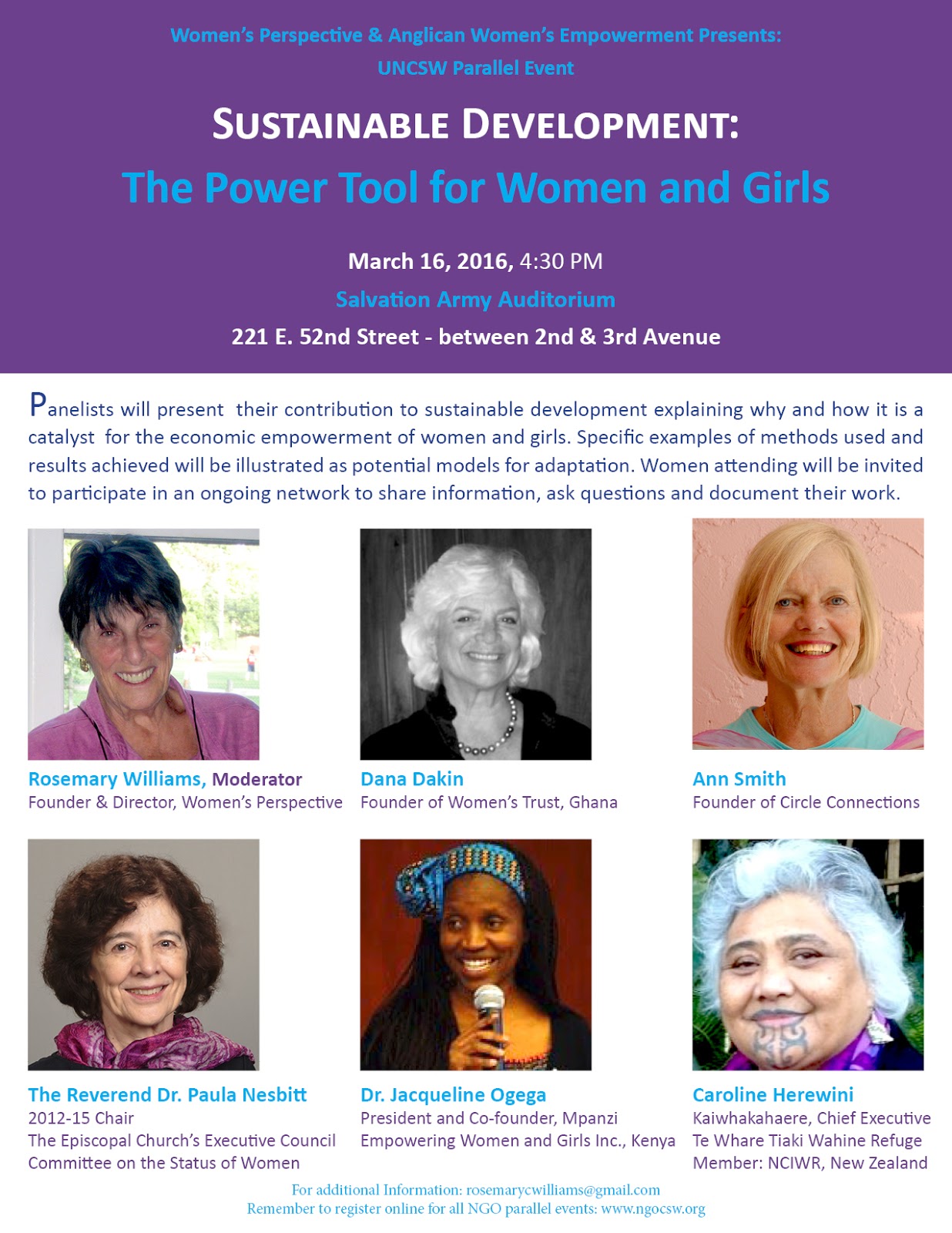
Meet Ann Smith and come to listen to her story on March 16. at the UNCSW Info below


I have devoted my life to work with women for women’s empowerment and global gender parity.  With more than thirty years of experience working globally, I have found that women have much more in common than they realized and when in a safe and loving circle setting, quickly form bonds of sisterhood.  In an egalitarian circle, everyone is equally valued and equally shares the information, resources and power.  In every chair is a leader, and the collective intelligence and wisdom is harvested leading to positive and sustainable actions locally and globally.  Too often women have not believed in themselves as capable of being a leader, but when their individual and collective leadership is affirmed and nurtured, they become transformational leaders in sustainable development, peace and justice.        
I served as founder and director of Women’s Work where I partnered with the building trade unions in giving job readiness training for women.  I served as director of Women in Mission and Ministry, Episcopal Church USA, for seventeen years where I was privileged to work with women around the world for women’s empowerment and advocacy.  I served as director of Global Education Associates co-creating Indigenous Women’s Pathways leadership program, African and US AIDS Prevention Coalition, Millionth Circle Initiative and Earth Child Institute.  I am co-founder and director of Circle Connections, co-author of Stories from the Circle, Women Prints, Women’s Uncommon Prayer and Women’s Round Calendar.
I am currently working on a women’s Spiritual Leadership resource and training of facilitators program for the Society of the Companions of the Holy Cross and the Mother Earth’s 2017 Round Calendar, Healthy People, Healthy Planet.  This whimsical and meaningful one-of-a-kind calendar with a reflection guide connects people of all ages to nature. 
 I live in Naples, Florida, with husband and two cats.     
Ann Landaas Smith, SCHC
Society of the Companions of the Holy Cross
239-682-1260 


Thursday, March 10, 2016

Meet Jackie Ogega and come to listen to her story on March 16. at the UNCSW Info below


Jackie Ogega, Ph.D, has over 20 years of experience in managing international development projects on women’s empowerment, child safeguarding, protection, education, training and policy development. She is the co-founder and president of Mpanzi empowering women and girls (www.mpanzi.org ). Jackie has worked for various humanitarian organizations including World Learning, Catholic Relief Services, Religions for Peace, Caritas and the University of Nairobi. She has over 30 years’ of experience living and/or working in a developing country, and has travelled to over 34 countries. A survivor of violence, jackie uses her personal narrative as a lens for her work. Jackie has a doctorate in peace research, a masters in gender and development studies, a bachelors in education and various advanced training. 

Monday, March 7, 2016

Meet Paula Nesbitt and come to listen to her story on March 16. at the UNCSW Info below


Paula believes that, "In mutual conversation across contexts, women have the potential to rethink prevailing economic models and implement others that are relational, mutually supportive, and sustainable."

We hope to have that kind of conversation on March 16, please join us. 


Paula Nesbitt

Maria and I sat in the sand, talking in our limited Spanish--a second language for both of us. The experience would soon transform my scholarship and worldview. I had gone to Mexico for some rest, but was bored with the resort life. Nearby, an indigenous group from the mountainous region to the southeast had its headquarters for beach vending, and I wandered over to learn more. Several said that I needed to talk with Maria, whom they respected as smart and wise.
A few years younger than me, Maria wanted to know about my education and what I did. She had wanted an education but never went to school, because at age five she had to care for her younger siblings when her mother died. I was an assistant professor with a Harvard PhD in sociology and an Episcopal priest. But when she heard that I was single and had no children, she was deeply saddened on my behalf. We sat together as equals, realizing how much we needed to learn from our varying contexts about how differently women are empowered or not.

Since then, through global feminist movements I’ve sought a way forward in my university teaching and scholarship, past the dominance-marginalization and identity-politics discourses to those that seek to understand one another’s differences and find places of common ground for mutual support. As part of the Episcopal Church’s Executive Council Committee on the Status of Women, 2009-15, we collaborated on resolutions cutting across culture and status, such as maternal health, violence against women and fighting human trafficking, as well as empowerment for both lay and clergywomen. Researching the Anglican Communion’s indaba process during that time, I encountered how empowering cross-cultural women’s constituency groups can be, and the varied ways they’ve sought to improve the status of women. In mutual conversation across contexts, women have the potential to rethink prevailing economic models and implement others that are relational, mutually supportive, and sustainable.